Snapshot
-
- 57% of prospective clinical trial participants rank financial transparency as very important: it is a decisive factor before enrollment.
- One in three global trial participants receive no compensation: and nearly half of European participants (49%) received no reimbursement at all.
- Checks are the most common reimbursement method but among the least convenient: only 51% of participants rate them as convenient, pointing to a fixable gap in how trials pay people.
When we talk about barriers to clinical trial participation, we often focus on eligibility criteria or geographic access. Financial concerns get less attention, but they drive both enrollment hesitation and dropout rates.
The latest CISCRP Perceptions and Insights Study, which is the largest global assessment of patient experiences in clinical research with over 12,800 respondents, reveals just how much financial realities matter. This study reinforced what we’ve heard from patients for years and supports why we do the work that we do. It demonstrated how often patient’s financial concerns are overlooked, despite their measurable impact on trial success.
Financial transparency shapes enrollment decisions
Financial transparency is a decisive enrollment factor: 57% of prospective participants say knowing potential costs, reimbursements, and compensation is “very important” before deciding to join a trial, ranking it third overall, just behind medical procedures required and study center location.
When patients choose between two studies, the availability of reimbursement is the second most important factor they consider when deciding to participate. The only thing more important is information about the study drug itself. Financial support ranked ahead of distance to clinic and virtual visit options.
Patients are making rational economic assessments about whether they can afford to participate, even when they want to find a treatment that can help them and others.
One in three trial participants receive no compensation: what’s driving the gap?
The study revealed that one in three participants received no compensation or reimbursement during their trial: 49% of participants in Europe received nothing compared to 13-20% in other regions. While regulatory differences play a role, this gap raises questions about how participants are being supported across different healthcare systems.
Many participants also face out-of-pocket expenses they may not have accounted for when signing up: this includes expenses such as travel costs, parking, meals during long visit days, and childcare. For patients managing the physical and emotional demands of a health condition, these costs may determine whether they continue participation.
This challenge is especially acute in rare disease trials. Patients with rare conditions are often geographically dispersed, meaning they may need to travel significant distances to reach a qualified study site. Some fly across the country for every visit. The financial burden of that travel, including flights, hotels, meals, and lost income, can be prohibitive. When compensation and reimbursement processes are slow, opaque, or limited to a single inconvenient payment method, these patients face a difficult choice between their health and their finances. Removing financial barriers in rare disease trials is not just a quality-of-life improvement: it is often the difference between adequate enrollment and a trial that patients cannot complete.
Payment methods create friction
Among participants who received compensation, checks were the most common payment method (20%) but had the second lowest convenience rating at 51%, just ahead of gift cards (49%). By comparison, 66% strongly agreed that cash was convenient, 58% rated digital wallets and direct pay as convenient, and 56% found prepaid debit cards convenient.
When reimbursement is slow or cumbersome, it adds friction to an already demanding experience. For participants living paycheck to paycheck or facing substantial medical expenses, delayed reimbursement can create financial stress that affects their ability to continue in the trial.
Compensation drives retention
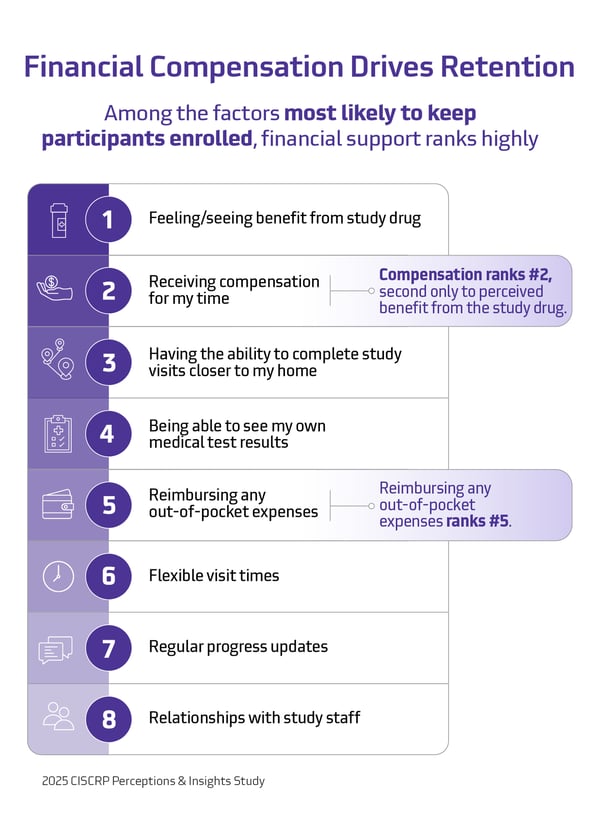
Compensation is the second most important factor in keeping participants enrolled, trailing only perceived benefit from the study drug itself. Reimbursing out-of-pocket expenses ranked fifth. Financial support matters more for retention than flexible visit times, regular progress updates, or relationships with study staff. Those other factors help, but compensation addresses a fundamental concern that determines whether someone completes a trial or withdraws early.
How do we create a better financial experience for clinical trial participants?
Purpose-built payment platforms today can streamline financial workflows and provide timely, convenient compensation. For instance:
- Multiple payment methods allow participants to choose what works for them
- Streamlined technology reduces processing delays
- Transparent tracking shows participants exactly when they'll be reimbursed
Greenphire Patient Payments provides streamlined reimbursement and stipend management with flexible payment methods across more than 30 currencies, so that compensation supports participation rather than adding burden. When Greenphire Travel is included in a study, patients don’t incur out-of-pocket travel related costs, as those are covered up front.
There's also a mindset shift needed. Participant compensation deserves attention as a core component of patient experience, not a back-office task. When someone volunteers their time and contributes to advancing science while managing a health condition, prompt and fair compensation is fundamental.
Supporting patient altruism with practical action
The CISCRP data shows that 50% of participants join trials to advance science and treatment for their disease, while 40% do so to help others. This altruism deserves practical support: clear upfront communication about costs and compensation, fair reimbursement that covers participation expenses, fast convenient payment methods, and transparency throughout.
The industry has made significant progress in trial design and patient engagement. Financial support deserves the same attention. When participants volunteer their time and health, they should not also bear the financial cost of doing so. Suvoda, through Greenphire Patient Payments and Greenphire Travel, is built on the principle that removing financial barriers is not an operational detail but a prerequisite for accessible, diverse, and successful trials. Honoring the generosity of patients who advance medicine starts with paying them promptly, fairly, and conveniently.
Author

Heather Horville
Solutions Consultant,
Suvoda
WHITEPAPER
Explore a new whitepaper that shares key highlights from the 2025 CISCRP Perceptions and Insights Study
- Travel continues to disrupt participation.
- Communication gaps make participant experiences harder.
- Based on insights from more than 12,800 respondents worldwide, this whitepaper shares where burden persists and where meaningful improvements are within reach.