Author: Kathy Kohler, VP of Customer Success at Suvoda
Snapshot:
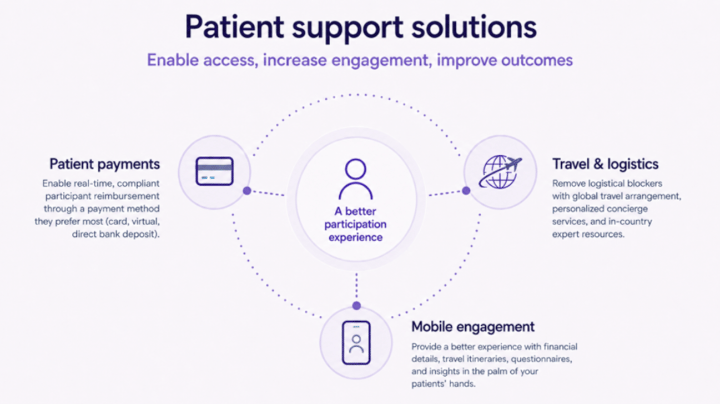
- Travel support reduces a major participation barrier: Coordinated travel helps ease one of the most common burdens patients face when joining and staying in a clinical trial.
- Patient payments help remove financial burdens for patients: Faster, more flexible reimbursement can reduce out-of-pocket strain and make participation more manageable.
- User-friendly tech and patient app connect the patient experience: A single mobile hub brings study tasks, reminders, travel details, and payments together in one place.
Clinical trial participation asks a lot of patients and caregivers. They may need to travel long distances, take time away from work or family, pay upfront for trial-related expenses, complete diaries or questionnaires, and keep track of changing study requirements.
For sponsors and CROs, these burdens are not just patient experience issues. They can affect enrollment, retention, protocol compliance, data quality, and study timelines.
That is why patient centricity needs to move beyond intent. Patients need practical support at the moments where participation becomes difficult. Modern clinical trial technology can help by simplifying daily tasks, improving communication, reducing financial and logistical friction, and giving participants a clearer view of what comes next.
Why patient engagement is important to clinical trial success
Patient centricity is often discussed as a principle. In practice, it comes down to whether a trial is manageable for the people participating in it. Protocol complexity continues to increase, and patient expectations are changing just as quickly. Participants increasingly expect the same convenience and transparency they experience in other parts of their daily lives, and they bring that same expectation into the trials they join.
Clinical trials depend on steady patient participation so new therapies can be accurately studied. When patients drop out, sponsors may need to replace participants, timelines can extend, and patients may wait longer for new treatment options—an especially meaningful concern in rare disease studies, where eligible participants are already limited.
A patient may be willing to join a study, but participation can quickly become difficult when support is fragmented. Travel may be hard to coordinate. Reimbursements may take too long. Study reminders may come from different systems. Patients may not know where to find key information or whom to contact when something changes.
When trial systems are disconnected, sites often become the integration layer. Coordinators end up answering travel questions, checking on payment status, sending reminders, and helping patients navigate multiple technologies. Every disconnected process adds work for sites and friction for patients. Improving the patient experience is not only about making things easier for participants, but it is also about reducing the operational burden placed on study teams.
These challenges matter because every point of friction can increase the risk of missed visits, delayed data, site burden, and participant dropout. When sponsors invest in technology and services that support patients across the trial journey, they are also investing in stronger trial execution.
A more patient-centered approach gives participants clearer communication, easier access to study resources, and more confidence that the practical realities of participation have been considered from the start.
Travel support helps reduce one of the largest patient burdens
Travel is one of the most significant logistical challenges in clinical trial participation. Research has shown that travel inconvenience is a leading reason patients decline or drop out of a trial, and many potential participants live more than two hours from the nearest study center.¹
For patients and caregivers, travel is not a single task. It can involve transportation, lodging, meal coordination, accessibility needs, caregiver arrangements, time away from work, and uncertainty about what costs will be covered. For global studies, these challenges become even more complex.
Without the right support, travel can become a barrier to participation, especially for patients managing serious or chronic conditions. It can also increase administrative work for sites, which are often left helping patients navigate logistics while managing already demanding study responsibilities.
Technology- and service-enabled travel support can help simplify this experience. With coordinated booking, clear itinerary details, reimbursement visibility, and support for patient-specific needs, sponsors can reduce logistical friction while giving patients a more predictable path through the trial.
Patient payments help reduce financial strain
Financial burden is another practical barrier that can affect whether patients join or stay in a study. Even when trial-related costs are reimbursable, patients may still need to pay out of pocket first and wait for repayment. For some households, that delay can make participation difficult or unrealistic.
Participants are asking for better financial support. In the 2025 CISCRP Perceptions and Insights Study, “receiving compensation for my time” ranked second when participants were asked what would make clinical trials less disruptive.¹
Patient payments technology helps address this challenge by making reimbursement faster, more transparent, and easier to manage. Participants can receive stipends or reimbursements through flexible payment options, track payment status, and better understand what has been paid and what is pending.
For sites, a more seamless and streamlined payment process can also reduce administrative burden. Instead of manually tracking reimbursement requests or answering repeated payment questions, site teams can focus more time on patient care and study execution.
For sponsors and CROs, patient payments are more than a convenience to the participants in their study. They are a practical way to reduce financial friction, support retention, and make participation feel more manageable.
The Suvoda App brings the patient experience into one place
Patients don't think about clinical trials in terms of technologies. They think about the tasks they need to complete. They need to know when their next visit is, whether transportation has been arranged, whether they've been reimbursed, and whether there are study activities still waiting on them. When those tasks are spread across multiple tools, participation becomes more complex. Bringing them together into a single experience helps reduce confusion, improve transparency, and make participation easier to manage.
The Suvoda App serves as a single patient-facing hub for the clinical trial journey. Patients can access study reminders, complete questionnaires and daily diaries, book rides and view travel details, and track payment status through one mobile experience.
This kind of connected experience can help patients feel more informed and in control. Instead of waiting for site staff to answer every logistical question, participants can see what they need, when they need it, and where they are in the process.
For sites, the benefit is also practical. When patients have easier access to reminders, travel information, payment updates, and study tasks, site teams can reduce repetitive administrative work and focus on higher-value support.
The Suvoda Platform supports a more connected patient journey
Patient centricity becomes more effective when it is built into the systems that support the trial. Travel, payments, scheduling, reminders, questionnaires, and site communication should not function as separate pieces of the patient experience.
Suvoda brings these touchpoints together through the Suvoda Platform, connecting patient-facing technology with the clinical and financial workflows that support trial execution. Suvoda software and services help simplify travel coordination, streamline patient payments, support patient-site communication, and make it easier for participants to complete questionnaires and daily diaries.
The result is a more unified experience for patients and sites. Patients receive clearer support across the journey. Sites spend less time managing fragmented processes. Sponsors and CROs gain a more integrated and transparent approach to reducing patient burden while supporting trial performance.
The future of patient centricity is not adding more tools to the clinical trial ecosystem. It is creating a connected experience that reduces friction across the entire participant journey. Sponsors that successfully align travel, payments, communication, and study activities into a unified experience will be better positioned to improve engagement, reduce site burden, support retention, and execute more efficient trials.
Clinical trial participation will always require commitment from patients and caregivers. But with the right technology and services, the experience can feel less fragmented, less burdensome, and more human.
Authors

Kathy Kohler
VP of Customer Success,
Suvoda
Footnotes
- Center for Information and Study on Clinical Research Participation. 2025 Perceptions & Insights Study. Published 2025.