Author: Kyle Renick, Global Study Manager, Suvoda
Snapshot:
- Travel is a top source of disruption: 49% say traveling to the study clinic was the most disruptive factor
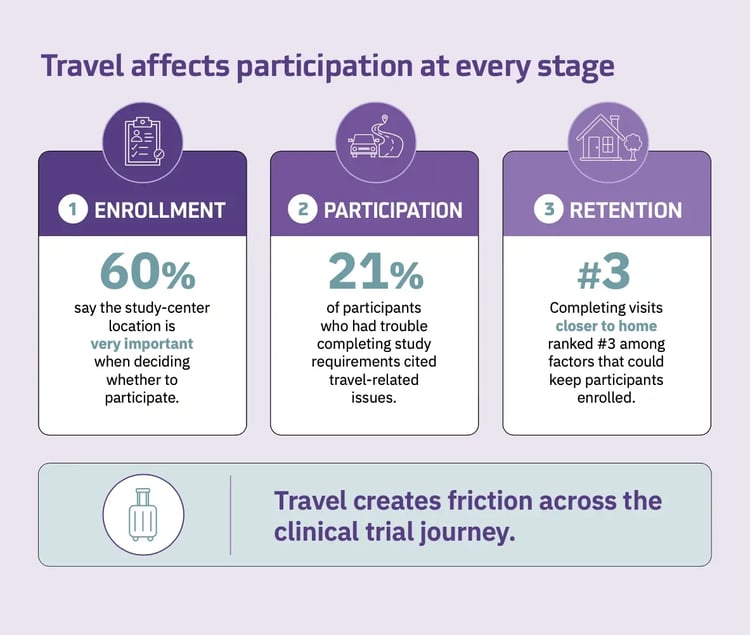
- Travel impacts protocol compliance: 21% of participants who experienced problems completing studies cited travel-related issues as the cause
- Distance matters for retention: Completing study visits closer to home ranked third among factors that keep participants enrolled
The latest Perceptions and Insights Study from CISCRP (Center for Information and Study on Clinical Research Participation) surveyed over 12,800 participants globally, and the findings on travel logistics caught my attention. Travel stands out as a primary barrier—one that affects both who can participate and who stays enrolled through completion.
Travel disrupts daily life
The CISCRP study found that 49% of participants who found their trial experience disruptive identified traveling to the study clinic as the main factor. This ranked higher than time requirements (30%), completing at-home requirements (29%), or missing work (25%).
I think the time investment helps explain why. Thirty-five percent of participants spent 30 minutes to one hour traveling one-way to their study clinic, while 16% spent 1-2 hours. When factoring in visit frequency and duration, travel becomes substantial. Time at the visit itself also took up considerable time in patients’ days: 30% of participants spent 30-60 minutes at each visit, and 21% spent 1-2 hours.
When asked what could have made participation less disruptive, 35% said not having to travel as far would help—ranking it as the top logistical improvement. Another 28% wanted a study nurse or doctor to come to their home for some visits, and 25% said assistance traveling to and from the study would reduce burden.
Travel affects who can participate
Before enrolling, 60% of potential participants indicated that the physical location of the research study center is “very important” in their decision. Distance ranked as the second most important logistical factor, just behind understanding the medical procedures required.
When choosing between two studies, 35% listed distance from home as one of their top three considerations. This makes proximity the third most important decision factor overall—behind only study drug details and reimbursement availability.
Rural participants, people without reliable transportation, working adults who can't easily take time off, and caregivers managing multiple responsibilities face compounded challenges. Travel burden disproportionately excludes populations already underrepresented in clinical research.
Travel impacts compliance and retention
The consequences extend to study compliance rates and retention as well. 21% of participants who experienced problems completing study requirements cited travel-related issues as the cause. This ranked among the top reasons for protocol non-compliance, alongside time-consuming visits and too many procedures.
When participants ranked what would keep them enrolled through trial completion, having the ability to complete study visits closer to home ranked third. It placed ahead of seeing medical test results, flexible visit times, and regular progress updates. Transportation provided to and from the study clinic ranked in the top ten among retention factors.
What strikes me is how travel burden creates friction at every stage—enrollment, compliance, and retention.
Clinical trial technology and services can reduce travel burden
The industry has tools to address travel barriers while maintaining data quality and regulatory compliance.
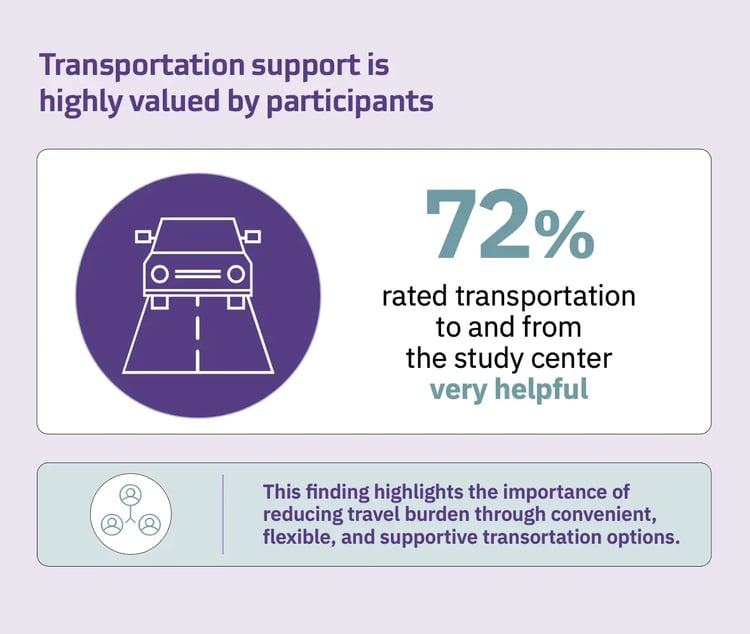
I find the participant feedback encouraging here. Seventy-six percent of participants who had study visits at home or close to home rated that arrangement as “very helpful”—the highest rating among all supportive services. 72% found transportation to and from the study center “very helpful,” and 24% said the availability of supportive services like hotel accommodations and travel assistance would influence their choice between two studies.
What can sponsors do to plan for travel burden?
Reducing travel burden requires intentional study design. For example, during protocol development sponsors can:
- Evaluate whether every visit needs to happen at the study center.
- Consider geographic distribution of sites relative to target populations.
- Build in flexibility for participants who face transportation challenges.
Clear communication during recruitment is another factor. Participants need to know what they're committing to—not just visit frequency but actual distance and time required. When travel is unavoidable, provide concrete support: transportation assistance, parking reimbursement, accommodation for overnight stays, and concierge support for patients who will experience an outsized travel impact, as is often the case in rare disease trials.
Greenphire Travel and its concierge coordinators are there for patients
Greenphire Travel is an excellent example of what good looks like when supporting clinical trial participants. We provide comprehensive global travel coordination and accommodation services with dedicated concierge support across more than 40 countries.
Here’s what that support can look like: When a study enables Greenphire Travel to support the full visit journey, participants have minimal travel-planning responsibilities. Each participant is assigned a concierge coordinator who works with the site and participant to arrange transportation, airfare, accommodations, reimbursements, and more.
For each in-person visit, the coordinator handles all transportation from the participant’s home to the airport, hotel, and study site—and back home after the visit. Hotel and travel payments are arranged in advance, so participants only need to provide identification at check-in. After returning home, participants can submit receipts for any out-of-pocket expenses, and the concierge coordinator manages the reimbursement process. That level of support lightens the travel load for participants, and it can pay off in stronger enrollment and retention.
Participating in a clinical trial already demands considerable effort from patients managing health conditions. The CISCRP findings show that travel amplifies this burden in ways that can limit who can participate and who completes trials. Addressing travel barriers expands access, strengthens retention, and creates a more sustainable research ecosystem.
Authors
Kyle Renick
Global Study Manager, Suvoda
 WHITEPAPER
Explore a new whitepaper that shares key highlights from the 2025 CISCRP Perceptions and Insights Study
- Travel continues to disrupt participation.
- Communication gaps make participant experiences harder.
- Based on insights from more than 12,800 respondents worldwide, this whitepaper shares where burden persists and where meaningful improvements are within reach.